Originally published: 19th November 2013 | Last updated: 22nd April 2026
Welding terminology can feel overwhelming, especially if you’re new to the industry.
This A–Z welding glossary breaks down the most common welding terms in plain English, helping you understand processes, equipment, and techniques used across fabrication and engineering.
What are welding terms?
Welding terms are the technical words used to describe welding processes, equipment, and techniques. Common examples include MIG welding, TIG welding, arc welding, and weld pool.
Contents
How to Use This Welding Glossary
If you’re new to welding, start by understanding the primary welding processes, including MIG, TIG, and arc welding.
If you’re more experienced, use this glossary as a quick reference for specific terms or techniques.
A
Popular “A” welding terms:
Active fluxes, AC current, arc welding, arc length
Active Fluxes
Active fluxes are materials used during welding that alter the chemical composition of the weld metal. They are typically used in controlled applications where weld properties need to be adjusted, usually in single or limited multi-pass welds.
Acceptable Weld
An acceptable weld is one that meets the required standards or specifications for strength, quality, and appearance, based on the application.
Actual Throat
The actual throat is the shortest distance between the weld root and the face of a fillet weld. It is a key measurement used to determine weld strength.
Aging
Aging is a process where metals or alloys are held at room temperature or reheated after shaping, improving strength and hardness. This is often used to increase stability through controlled structural changes.
Related: heat treatment processes guide
Air Carbon Arc Cutting
A cutting process that removes molten metal using a carbon electrode and a jet of compressed air. It is commonly used for gouging, weld removal, and surface preparation.
Air Hardening
Air hardening refers to steels that harden when cooled in air after being heated above a critical temperature. This process can increase strength but may be less effective on thicker materials.
Allotropic
A material is allotropic when it can exist in different crystal structures depending on temperature. This affects how metals behave during heating and cooling.
Allotropic Change
An allotropic change is the transformation of a metal from one crystal structure to another, resulting in different physical properties.
Alternating Current (AC)
Alternating current (AC) is an electrical current that changes direction periodically. In welding, it is commonly used for aluminium TIG welding due to its ability to manage oxide layers.
View AC/DC TIG welders
Ampere
An ampere (amp) is the unit used to measure electrical current. In welding, amperage directly affects heat input and weld penetration.
Anneal
Annealing is a heat treatment process where metal is heated and then slowly cooled to reduce hardness and relieve internal stresses.
Annealing
Annealing refers to the process of applying heat treatment to improve ductility, reduce brittleness, and make materials easier to machine or form.
Explore pre- and post-weld heat treatment equipment
Arc Blow
Arc blow occurs when magnetic forces deflect the welding arc, making it unstable and harder to control. It is more common when using direct current (DC).
Arc Energy
Arc energy refers to the amount of heat generated during welding. It influences weld penetration, bead shape, and overall weld quality.
Arc Length
Arc length is the distance between the electrode and the workpiece. Maintaining the correct arc length is critical for consistent weld quality.
Arc Time
Arc time is the total time during which the welding arc is active while creating a weld.
Arc Voltage
Arc voltage is the electrical potential across the welding arc. It affects arc stability and weld bead characteristics.
Arc Welding
Arc welding is a group of welding processes that use an electric arc to join metals. It can be performed with or without filler material, depending on the method.
Browse arc welding machines for sale
Arc Welding Electrode
An electrode is the component that conducts electrical current to the arc and may also supply filler material, depending on the welding process.
Arc Welding Gun
A welding gun is used in processes like MIG welding to feed wire, transfer current, and direct shielding gas to the weld area.
Arc Welding Torch
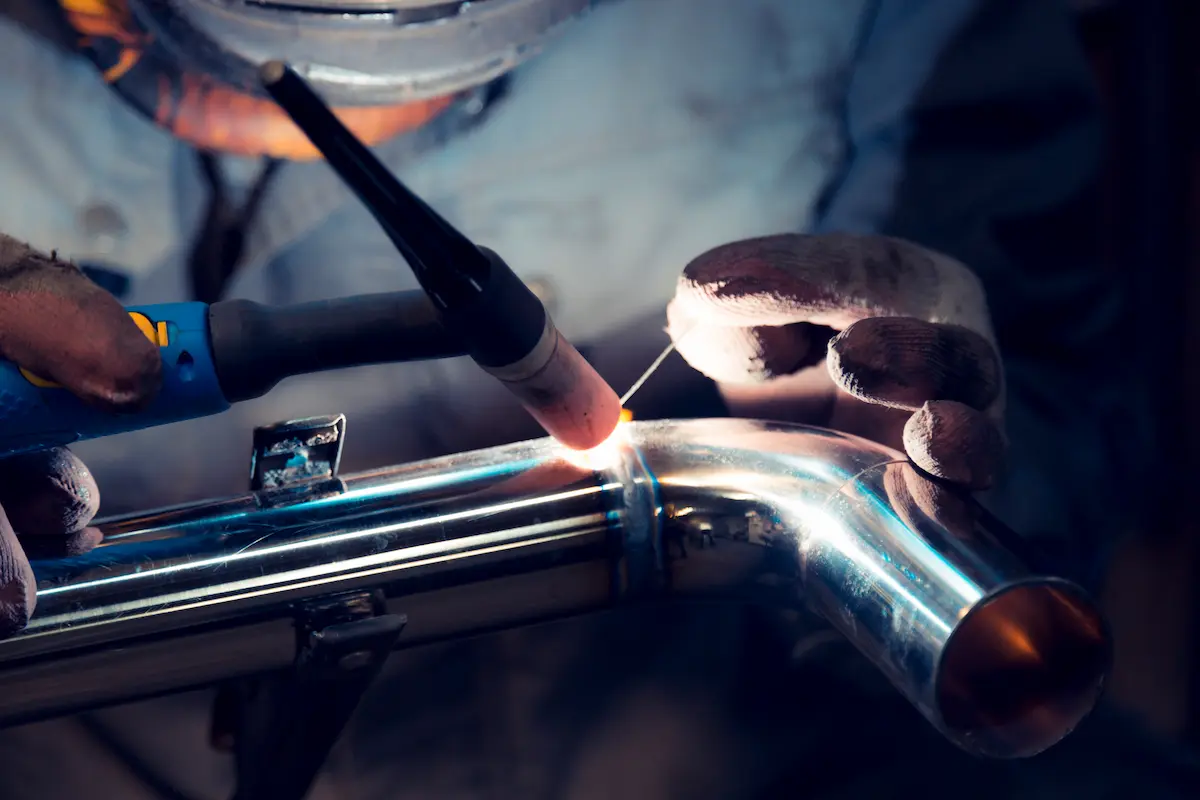
A welding torch is typically used in TIG welding to hold the electrode and control the arc and shielding gas.
As-Cast Structure
The structure of a metal in its original form after casting, before any further processing such as rolling or forging.
As-Welded
Describes the condition of a weld immediately after welding, before any additional treatments such as heat treatment or machining.
Austenite
Austenite is a high-temperature crystal structure found in steel and certain alloys. It plays a key role in determining mechanical properties during heating and cooling.
B
Popular “B” welding terms:
Back gouging, bevel, blowhole, brazing, base metal
Back Gouging
Back gouging is the removal of weld metal from the reverse side of a joint to ensure full penetration and improve weld quality when welding from the opposite side.
Backhand Welding
Backhand welding is a technique where the torch or welding gun is directed back towards the completed weld. It is often used for better control and penetration in certain applications.
Backing Ring
A backing ring is a support placed behind a weld joint, commonly used in pipe welding to help achieve proper penetration and consistent weld formation.
Base Metal
Base metal is the material being welded, cut, or joined. Its composition determines the welding process, filler material, and settings required.
Bevel
A bevel is an angled edge prepared on a workpiece to allow deeper weld penetration and stronger joints.
Bevel Angle
The bevel angle is the angle between the prepared edge of a material and a reference surface. It plays an important role in weld penetration and joint strength.
Common in plasma cutting and edge preparation, view our range of bevelling equipment.
Bevel Cutting
Bevel cutting is a cutting technique where the torch is angled to create a sloped edge on the material, often used to prepare joints for welding.
Explore plasma cutting solutions
Bevel Groove Weld
A bevel groove weld is a type of weld made in a joint where one or both pieces have been bevelled to allow full penetration.
Binary Alloy
A binary alloy is a metal made from two elements. The combination of these elements affects strength, corrosion resistance, and weldability.
Blowhole
A blowhole is a weld defect caused by trapped gas within the weld metal. It appears as small cavities and can weaken the weld if not controlled.
Bonded Fluxes
Bonded fluxes are manufactured by combining powdered materials and baking them at low temperatures. They allow additional alloying elements to be added during welding.
Braze
Brazing is a metal joining process where a filler metal is melted and drawn into a joint without melting the base metals. It is commonly used for joining dissimilar materials.
Brittleness
Brittleness is the tendency of a material to fracture suddenly without significant deformation. This can be a concern in weld quality and material selection.
Buildup
Buildup is the process of adding material to a surface to restore size, shape, or function. It is often used in repair or wear-resistant applications.
Related: cladding and hard-facing guide.
C
Popular “C” welding terms:
Carbon steel, cladding, current, consumables, cracking
Carbide
A carbide is a compound formed between carbon and another element, creating a very hard and wear-resistant material.
Carbide Precipitation
Carbide precipitation occurs when carbon atoms combine with metals (such as chromium) during heating and cooling, forming carbides at grain boundaries. This can affect corrosion resistance, particularly in stainless steels.
Carbon Steel
Carbon steel is a widely used metal where strength and properties are primarily determined by its carbon content. It is commonly used in fabrication and welding applications.
Case Hardening
Case hardening is a heat treatment process that creates a hard outer surface while maintaining a softer, tougher core. The depth of hardness depends on treatment time.
Related: heat treatment equipment
Cast Steel
Cast steel is a metal that has been melted and poured into a mould, then cooled to form a solid shape.
Cellulose
Cellulose is an organic compound used in some welding electrodes. It helps produce shielding gases and influences arc characteristics during welding.
Cementite
Cementite is a hard compound of iron and carbon (Fe₃C) found in steel. It contributes to hardness and brittleness in metal structures.
Chip Test
A chip test is a method used to identify metals by chipping the surface and observing the structure beneath.
Chopper
A chopper is a type of plasma power source that uses semiconductor switching to efficiently control electrical output.
Cladding
Cladding is the process of applying a layer of material to a surface to improve corrosion resistance, wear resistance, or strength.
Used with weld cladding and overlay machines.
Clear Puddle
A clear puddle refers to molten weld metal that is free from slag or instability, making it easier to control during the welding process.
Coating Concentricity
Coating concentricity refers to the evenness of the coating applied around an electrode core. Consistency is important for stable arc performance.
Coefficient of Friction
The coefficient of friction measures how easily one surface slides over another. Lower values indicate less resistance and wear.
Cold Drawing
Cold drawing is the process of pulling metal through a die to reduce its size at temperatures below its recrystallisation point.
Cold Rolling
Cold rolling reduces the thickness of metal by passing it through rollers at low temperatures. Improving strength and surface finish.
Cold Working
Cold working refers to permanently deforming metal below its recrystallisation temperature, increasing strength through work hardening.
Complete Fusion
Complete fusion occurs when the weld metal fully bonds with the base metal across the joint. Ensuring structural integrity.
Complete Joint Penetration
Complete joint penetration is when the weld extends through the full thickness of the joint. Creating maximum strength.
Composite Electrode
A composite electrode is made from multiple materials combined to improve weld properties such as stability, shielding, or strength.
Compressive Strength
Compressive strength is the ability of a material to resist forces that attempt to crush or compress it.
Conductor
A conductor is a material that allows electricity to flow easily. Metals are commonly used as conductors in welding systems.
Constant Current
A constant current (CC) power source maintains a steady amperage even when the voltage changes. It is commonly used in processes like stick welding.
Explore welding power sources
Constant Voltage
A constant voltage (CV) power source maintains a stable voltage while allowing current to vary. It is typically used in MIG welding.
Constricted Arc
A constricted arc is a focused plasma arc that is shaped by the nozzle, producing a narrow, high-energy cutting or welding stream.
Consumables
Consumables are parts that wear out during welding or cutting, such as electrodes, nozzles, and shielding components.
Contact Tip
A contact tip transfers electrical current to the welding wire in MIG or flux-cored welding systems.
Contact Tube
A contact tube is a component that delivers electrical current to a continuous electrode.
Contact Tube Setback
Contact tube setback is the distance between the contact tip and the end of the nozzle. Affecting arc stability and performance.
Convex Fillet Weld
A convex fillet weld has a curved outward surface, which can affect strength and stress distribution.
Convexity
Convexity refers to the height of a weld bead above the surface, measured from the weld face.
Covered Electrode
A covered electrode is a welding rod coated with flux to provide shielding, stabilise the arc, and improve weld quality.
Crack
A crack is a fracture in a weld or material that can compromise structural integrity.
Crater
A crater is a small depression left at the end of a weld bead, which can lead to cracking if not properly filled.
Creep
Creep is the slow deformation of a material under prolonged stress, especially at high temperatures.
Critical Cooling Rate
The critical cooling rate is the speed at which metal must cool to achieve a specific microstructure, such as full hardening.
Cryogenic Temperatures
Cryogenic temperatures refer to extremely low temperatures and are typically associated with liquefied gases.
Current (Welding Current)
Welding current is the flow of electricity used to generate the arc. It directly affects penetration, heat input, and weld quality.
Current Density
Current density is the amount of electrical current flowing through a given cross-sectional area. Higher density results in deeper penetration and a more concentrated arc.
Cut Angle
The cut angle is the angle created during cutting processes such as plasma cutting. It affects edge quality and weld preparation.
Cutting Gas
Cutting gas is directed through the torch to form a plasma or flame that enables cutting. It also helps remove molten material from the cut.
Read more in our guide.
Cylindrical Nozzle Design
A cylindrical nozzle design controls the flow of gas in cutting or welding equipment, affecting arc shape and performance.

D
Popular “D” welding terms:
DCEN, DCEP, defect, dilution, distortion, duty cycle
DCEN (Direct Current Electrode Negative)
DCEN is a welding setup where the electrode is negative, and the workpiece is positive. It provides deeper penetration and is commonly used in TIG welding.
DCEP (Direct Current Electrode Positive)
DCEP is a welding setup where the electrode is positive, and the workpiece is negative. It produces a wider, shallower weld and is often used in stick welding.
Defect
A defect is a flaw in a weld or material that prevents it from meeting required standards or specifications. Common examples include cracks, porosity, and lack of fusion.
Deoxidisers
Deoxidisers are elements such as manganese, silicon, or aluminium added during welding to prevent oxygen from forming defects like porosity in the weld metal.
Deposited Metal
Deposited metal is the filler material added during welding, brazing, or soldering to form the weld.
Deposition Efficiency
Deposition efficiency measures the quantity of the electrode material that becomes part of the weld, expressed as a percentage.
Deposition Rate
The deposition rate refers to the amount of weld metal deposited over a period of time. Typically measured in weight per hour.
Depth of Bevel
The depth of bevel is the distance from the surface of the base metal to the root of the prepared edge.
Depth of Fusion
Depth of fusion refers to how deep the weld penetrates into the base metal or previous weld layer. Greater depth generally improves weld strength.
Digging
Digging describes an arc characteristic that produces strong penetration into the base metal, often seen with certain electrode types.
Dilution
Dilution is the mixing of base metal with filler metal during welding. It affects the final chemical composition and properties of the weld.
Direct Current (DC)
Direct current is an electrical current that flows in one direction. In welding, it is widely used for stable arcs and controlled heat input.
Discontinuity
A discontinuity is any irregularity in a material’s structure. Not all discontinuities are defects, but they may affect performance.
Distortion
Distortion is the unwanted change in shape caused by heat during welding. It occurs as the metal expands and contracts during heating and cooling.
Divergency
Divergency refers to the tapered section of a cutting nozzle that helps control gas flow and improve cutting speed and quality.
Double Arcing
Double arcing occurs when the arc splits and attaches to both the nozzle and the workpiece, reducing cutting efficiency and potentially damaging equipment.
Downhill Welding
Downhill welding is a technique where the weld progresses downward. It is often faster but requires control to maintain weld quality.
Drag
Drag is the offset between the entry and exit points of the cutting arc or gas stream. It is influenced by cutting speed, pressure, and material thickness.
Drag Angle
Drag angle is the angle between the cutting jet and the surface of the material. It affects cut quality and edge finish.
Dross
Dross is solidified molten metal that sticks to the edge of a cut. It often needs to be removed to achieve a clean finished result.
Ductility
Ductility is the ability of a material to deform without breaking. Materials with high ductility are less likely to crack under stress.
Duty Cycle
Duty cycle refers to how long a welding machine can operate at a given output within a 10-minute period before needing to cool down.
Learn more about welding machine duty cycles
E
Popular “E” welding terms:
Edge preparation, electrode, elasticity, electrical stick-out, elongation
Edge Preparation
Edge preparation is the process of preparing the edges of materials before welding. This can include cutting, cleaning, or beveling to ensure proper fit-up and strong weld penetration.
Used with pipe saws, bevelling machines and edge prep tools
Effective Throat
The effective throat is the minimum distance between the weld root and the face of a fillet weld, excluding any excess convexity. It is used to determine weld strength.
Elastic Limit
The elastic limit is the maximum stress a material can withstand without permanent deformation. Beyond this point, the material will not return to its original shape.
Elasticity
Elasticity is the ability of a material to return to its original shape after being deformed by a load.
Electrical Stick-Out (Electrode Stick Out)
Electrical stick-out is the distance between the contact tip and the unmelted end of the wire in welding. It affects heat input, penetration, and the shape of the weld bead.
Electrode
An electrode is the component that carries electrical current to create the welding arc. In many processes, it also supplies filler material to form the weld.
Electrode Coating
Electrode coating is the layer applied to a welding rod that stabilises the arc, protects the weld pool from contamination, and improves weld quality.
Electrode Core Wire
The electrode core wire is the metal wire at the centre of a coated electrode. Its diameter determines the electrode size.
Electrode Extension
Electrode extension is the length of wire extending beyond the contact tip. It influences heat input and welding performance.
Electrode Holder
An electrode holder is a device used to grip the electrode and conduct electrical current during welding.
Electron
An electron is a negatively charged particle that moves around the nucleus of an atom. The movement of electrons creates an electrical current.
Element
An element is a basic substance that cannot be broken down further. Metals used in welding are often combinations of multiple elements.
Elongation
Elongation measures how much a material can stretch before breaking. It is usually expressed as a percentage of the original length.
Endurance Limit
The endurance limit is the maximum stress a material can withstand repeatedly without failing over time.
Erratic Arc
An erratic arc is unstable and difficult to control, often resulting in inconsistent weld quality and poor bead formation.
Eutectic Alloy
A eutectic alloy is a mixture of metals that melts and solidifies at a single, lower temperature than its individual components.
Extrusion
Extrusion is a manufacturing process where material is forced through a shaped die to create a specific cross-section.
F
Popular “F” welding terms:
Fillet weld, filler metal, flux, fusion, fatigue failure, flat welding position.
Face (Weld Face)
The weld face is the visible surface of a weld bead between the weld toes. It plays a key role in weld profile, strength, and inspection.
Face Bend Test
A weld test where the weld face is placed on the outer (convex) side during bending to assess ductility and detect surface defects.
Face Reinforcement
Excess weld metal deposited above the surface of the base material on the weld face. Controlled reinforcement can improve strength, but too much may require grinding.
Fatigue Failure
Failure of a material caused by repeated or cyclic loading, often occurring below the material’s ultimate tensile strength.
Fatigue Limit
The maximum stress a material can withstand indefinitely without failure under repeated loading conditions.
Fatigue Strength
The ability of a material to resist failure under cyclic or fluctuating stresses over time.
Ferrite
A soft, ductile crystal structure found in low-carbon steels at room temperature, contributing to formability and toughness.
Ferrite in Austenitic Stainless Steel
A small amount of ferrite in austenitic weld metal can improve crack resistance by refining the grain structure.
Ferrite Number (FN)
A standardised measure of ferrite content in stainless steel weld metal, used to predict weld performance and crack resistance.
Ferrous Metals
Metals that contain iron, including carbon steel, alloy steels, and stainless steels.
Filler Metal
The metal that’s added during welding, brazing, or soldering to form the joint.
Filler Wire
Filler metal that’s supplied as a wire, typically used in MIG, TIG, and automated welding processes. Wire type and diameter depend on the application.
Fillet Weld
A weld with a triangular cross-section that’s used to join surfaces at right angles, commonly found in T-joints, lap joints, and corner joints.
Fillet Weld Leg
The distance from the root of the joint to the toe of the fillet weld.
Fillet Weld Size
The dimensions of a fillet weld; typically defined by its leg length or throat thickness.
Flame Spraying (FLSP)
A thermal spraying process where material is melted using an oxy-fuel flame and projected onto a surface for coating or repair.
Flashback
A dangerous condition in which the flame travels back into the torch, potentially causing equipment damage or explosion if not controlled.
Flat Welding Position (PA Position)
A welding position where the weld is performed from above, with the weld axis horizontal. This is the easiest and most controlled welding position.
Flux (Welding Flux)
A substance used in welding to protect the molten weld pool from contamination by removing oxides and preventing atmospheric exposure. Used in processes like submerged arc welding and flux-cored welding.
Read our full breakdown of the submerged arc welding process.
Flux Cored Electrodes (FCAW Wire)
A tubular wire filled with flux material that provides shielding and improves weld quality. Commonly used in fabrication and structural welding.
Flux Voids
Areas within a flux-cored electrode where flux is missing, potentially leading to weld defects.
Forging
A manufacturing process where metal is shaped using compressive forces, often improving strength and grain structure.
Forehand Welding (Push Technique)
A welding technique where the torch or gun is directed in the direction of travel, producing a flatter, wider weld bead.
Friction Stir Welding (FSW)
A solid-state welding process where a rotating tool generates heat through friction to join materials without melting them.
Fuel Efficiency (Oxy-Fuel Welding)
A measure of how effectively fuel gas is used in welding or cutting operations.
Full Annealing
A heat treatment process that softens metal by heating it above its critical temperature and cooling it slowly to improve ductility and machinability.
Fumes (Welding Fumes)
Airborne particles that are produced during welding or cutting. Proper extraction systems are essential for safety and compliance with HSE regulations.
See our range of fume extractors in stock now.
Fused Fluxes
Fluxes that are produced by melting raw materials, then cooling and crushing them into particles. Known for low moisture absorption and consistent performance.
Fusion (Welding Fusion)
The process of melting and joining base metal (with or without filler metal) to form a weld.
Fusion Zone
The area of base metal that has melted and solidified during welding, forming part of the weld joint.
G
Popular “G” welding terms:
GMAW (MIG welding), GTAW (TIG welding), gas nozzle, gas regulator, globular transfer, groove angle.
Galling
A form of wear caused by friction between sliding metal surfaces, where material transfers and surfaces seize or tear.
Gas Ions
Ionised shielding gas particles that help to conduct electricity and stabilise the welding arc between the electrode and workpiece.
Gas Nozzle
The component at the end of a welding torch that directs shielding gas to protect the weld pool from contamination.
Gas Metal Arc Welding (GMAW/MIG Welding)
A welding process where an electric arc forms between a continuously fed wire electrode and the workpiece. Shielding is provided by an external gas such as argon or CO₂. Commonly referred to as MIG welding.
See our latest range of MIG welders for sale.
Gas Regulator
A device used to control and maintain consistent gas pressure from a cylinder to the welding torch.
Gas Tungsten Arc Welding (GTAW / TIG Welding)
A precise welding process using a non-consumable tungsten electrode and shielding gas. Commonly known as TIG welding, it produces clean, high-quality welds.
View all of our TIG welders in stock.
Globular Transfer
A metal transfer mode in MIG welding where molten droplets detach irregularly and fall into the weld pool, often producing more spatter.
Globular Transfer Mode
A specific transfer type where the droplet size is larger than the electrode diameter and transfer is inconsistent, typically at medium currents.
Gray Iron (Grey Iron)
A cast iron containing 2–4% carbon, where carbon exists as graphite flakes, giving it good machinability but lower ductility.
Groove Angle
The total included angle between the prepared edges of a joint prior to welding. It affects penetration and weld quality.
H
Popular “H” welding terms:
Heat-affected zone (HAZ), heat treatment, high frequency (HF), high alloy steel, hot crack, horizontal welding position,
Hadfield Steel
A high-manganese austenitic steel known for its exceptional impact resistance and work hardening properties.
Hafnium
A metal commonly used in plasma cutting electrodes due to its ability to withstand high temperatures and provide stable arc performance.
Hardenable Steel
Steel that can be hardened through rapid cooling (quenching), increasing strength and wear resistance.
Hardening
A heat treatment process where steel is heated and then rapidly cooled to increase hardness and strength.
Harsh Arc
A welding arc that is unstable, noisy, and produces excessive spatter, often caused by incorrect settings or poor parameters.
Heat Affected Zone (HAZ)
The area of base metal that does not melt during welding but undergoes structural changes due to heat. This zone can become brittle if cooled too quickly.
Heat Shield
A component at the front of a cutting or welding torch that provides electrical insulation and helps direct shielding gas.
Heat Treatment
Controlled heating and cooling of metals to alter their mechanical properties. Often used before or after welding (e.g. preheat or PWHT).
Browse our current range of new and used heat treatment machines.
Helix (Electrode)
The tendency of a welding wire or electrode to form a spiral when laid on a flat surface. Affecting the feed consistency.
Hertz (Hz)
A unit of frequency representing cycles per second, commonly used in electrical systems and welding power sources.
High Alloy Steel
Steel containing more than 10% alloying elements (such as chromium), often used for corrosion resistance and strength.
High Carbon Steel
Steel with higher carbon content (typically up to ~2%), offering increased hardness but reduced ductility.
High Frequency (HF)
A high-voltage, high-frequency current that’s used in TIG welding to start and stabilise the arc without contact.
Browse our range of TIG welding machines in stock.
High Frequency Discharge
The electrical discharge used to initiate plasma or TIG arcs by ionising the air gap between the electrode and workpiece.
High Speed Nozzle Design
A nozzle design used in cutting applications that increases gas velocity to improve cut quality and speed.
High Sulphur Steel
Steel with increased sulphur content to improve machinability, often used in automatic machining applications.
High Speed Steel (HSS)
A tool steel designed for cutting applications, maintaining hardness at high temperatures.
High Strength Cast Iron
Cast iron with enhanced tensile strength that’s often used in heavy-duty engineering applications.
Horizontal Welding Position
A welding position where the weld axis is horizontal, and the weld face lies in a vertical plane.
Hot Crack
Cracking that occurs in weld metal during solidification due to stress and shrinkage.
Hot Quenching
Controlling cooling rates by heating metal in a molten bath, instead of water or oil.
Hot Short
A condition where metal becomes brittle at high temperatures, often due to impurities like sulphur.
I
Popular “I” welding terms:
Incomplete fusion, incomplete penetration, inert gas, inter-pass temperature, inverter power source.
Impact Test
A test that measures the energy required to fracture a material under sudden or shock loading.
Inclusion
Entrapped foreign material in a weld, such as slag, tungsten, or oxides, that can weaken it.
Incomplete Fusion
A weld defect where fusion does not occur between the weld metal and base metal or between weld passes.
Incomplete Joint Penetration
A condition where weld metal does not extend through the full thickness of the joint.
Induced Current (Induction)
The generation of electrical current in a conductor that’s caused by a changing magnetic field.
Inductance
A feature in welding power sources (especially MIG) that controls the rate of current rise, affecting arc stability and spatter.
Inert Gas
A non-reactive gas, such as argon or helium, used to shield the weld pool from atmospheric contamination.
Ingot
A mass of metal cast into a specific shape for further processing.
Insulator
A material that resists the flow of electricity, such as ceramics, glass, or plastics.
Inter-pass Temperature
The minimum temperature of a weld between passes in multi-pass welding. Critical for maintaining weld integrity.
Inverter Power Source
A modern welding or cutting power supply that uses electronic components to reduce size, weight, and improve efficiency.
✔️ Browse our current stock of inverter welding and cutting machines.
J
Popular “J” welding terms:
Joint geometry, joint penetration, joint root, joint type.
Joint Geometry / Design
The shape and dimensions of a joint in cross-section prior to welding.
Joint Penetration
The distance the weld metal extends from the weld face into a joint, exclusive of weld reinforcement.
Joint Root
That portion of a joint to be welded where the members approach closest to each other. In cross-section, the joint root may be either a point, a line, or an area.
Joint Type
A weld joint classification based on five basic joint configurations: butt joint, corner joint, edge joint, lap joint, and T-joint. See our guide on the different welding joints and when to use them.
K
Popular “K” welding terms:
Kerf, killed steel, kilowatt.
Kerf
The opening through a material where metal is removed during any cutting operation. Kerf width varies by process; plasma arc cutting typically produces a narrower kerf than oxy-fuel cutting, making it preferable for precision work.
Killed Steel
Steel that has been sufficiently deoxidised during the melting cycle to prevent gases from evolving during solidification, producing a more uniform structure better suited to welding.
Kilowatt
A measurement of electrical power equal to 1,000 watts.
L
Popular “L” welding terms:
Lack of fusion, lap joint, local preheating, low hydrogen electrodes.
Lack of Fusion
A non-standard term for incomplete fusion.
Lack of Penetration
A non-standard term for incomplete joint penetration.
Lap Joint
A joint between two overlapping members in parallel planes.
Level Wound
Spooled or coiled filler metal wound in distinct layers such that adjacent turns touch.
Linear Discontinuity
A discontinuity with a length substantially greater than its width.
Linear Indication
A test result in which a discontinuity is displayed as a linear or aligned array during non-destructive examination.
Local Preheating
The heating of a localised area of a structure prior to welding. See our range of pre and post-heat welding systems.
Longitudinal Crack
A crack with its major axis oriented approximately parallel to the weld axis.
Low Alloy Steels
Steels containing small amounts of alloying elements (usually 1½% to 5% total alloy content). Significantly improve their mechanical properties compared to plain carbon steel.
Low Carbon Electrodes
A non-filler metal electrode used in arc welding and cutting, consisting of a carbon or graphite rod, which may be coated with copper or other materials.
Low Hydrogen Electrodes
Coated stick electrodes that are very low in hydrogen content, minimising the risk of hydrogen-induced cracking. Electrodes should be stored and re-dried in line with manufacturer recommendations.
M
Popular “M” welding terms:
Manual arc welding, martensite, MIG welding, MMA welding, mill scale.
Macroetch Test
A test in which a specimen is prepared with a fine finish, etched, and examined under low magnification to reveal weld structure and any discontinuities.
Malleableizing
An annealing operation that’s used to convert white cast iron into malleable cast iron, improving its ductility and machinability.
Manual Arc Welding
Welding with a coated electrode where the operator controls travel speed and electrode feed by hand. Also referred to as MMA welding or stick welding.
Martensite
A hard, brittle, needle-like crystal structure that forms in steel when austenite is cooled rapidly. Its formation in the heat-affected zone can lead to cracking if preheat and post-weld heat treatment are not applied correctly.
Matrix
The principal, continuous metallic constituent in which crystals or free atoms of other constituents are embedded, acting as a binder for the overall structure.
Mechanised Welding
A form of welding automation requiring manual adjustment of equipment controls in response to visual observation, with the torch or electrode held by a mechanical device. Examples include longitudinal seam welders and column and boom systems.
Melt Through
Visible root reinforcement that’s produced in a joint welded from one side.
Metal Active Gas (MAG) Welding
Similar to MIG welding but using an active shielding gas, commonly used for welding carbon and low-alloy steels.
Metal Inert Gas (MIG) Welding
An arc welding process wherein coalescence is produced by heating with an arc between a continuous consumable electrode and the workpiece, shielded by an externally supplied inert gas or gas mixture. Browse our MIG welders currently in stock.
Metallurgy
The science and technology of extracting metals from their ores, refining them, and preparing them for use.
Microstructure
The internal structure of a metal that’s only visible at high magnification after polishing and etching.
Mild Steel
An alloy of iron with a low content of carbon and other alloying elements such as manganese. The most commonly welded material in general fabrication.
Mill Scale
The iron oxide (FeO) layer found on the surface of hot-rolled steels. Should be removed prior to welding as it can cause porosity and poor fusion.
MMA (Manual Metal Arc) Welding
An arc welding process wherein coalescence is produced by heating with an arc between a covered metal (stick) electrode and the workpiece. Shielding is obtained from the decomposition of the electrode covering.
Mottled Iron
Cast iron with a structure consisting of a mixture of free cementite, free graphite, and pearlite.
N
Popular “N” welding terms:
Neutral flame, non-destructive examination, nozzle.
Neutral Flame
An oxy/fuel gas flame that has characteristics neither oxidising nor reducing.
Neutral Fluxes
Fluxes that produce little change to their mechanical properties when adjusting the voltage. Best used when welding on plate thickness of one inch or more.
Nondestructive Examination (NDE)
The act of determining the suitability of a material or component for its intended purpose using techniques that do not affect its serviceability.
Non-Ferrous
Containing no iron. Examples include aluminium, copper, and copper alloys.
Non-Transferred Arc
An arc that’s established between the electrode and the constricting nozzle of the plasma arc torch, where the workpiece is not in the electrical circuit.
Nozzle
A torch part containing a hole or orifice through which the arc passes. See our guide on prolonging the life of your plasma cutting consumables to get the most out of your consumable life.
Nozzle Diameter
The diameter of the nozzle through which the plasma arc passes. Also referred to as orifice diameter.
O
Popular “O” welding terms:
Open circuit voltage, out-of-position welds, overlap, oxy/fuel ratio.
Off-Centre
Refers to an electrode coating that is eccentric and thicker on one side than the other. Also referred to as fingernailing.
Ohm
Unit of electrical resistance to current flow.
Open Circuit Voltage
The voltage present at the electrode before the torch ignites and whenever the arc is extinguished, with the power source still active.
Orifice Diameter
The diameter of the nozzle through which the plasma arc passes. Also referred to as nozzle diameter.
Orifice Gas
The gas that’s directed into the torch to surround the electrode, which becomes ionised by the arc to form a plasma jet. Also referred to as plasma gas or cutting gas.
Out-of-Position Welds
Welds made in positions other than flat or horizontal fillets.
Overlap
The protrusion of weld metal beyond the weld toe or weld root.
Oxy/Fuel Ratio
The relationship of cubic feet of oxygen to cubic feet of fuel gas needed to achieve maximum flame temperature.
Oxygen Bore
The orifice in the cutting nozzle through which oxygen is directed at the plate for cutting, controlling the amount of oxygen consumed.
Oxygen Factor
The fuel efficiency multiplied by the oxy/fuel ratio for a given fuel. Used to determine the multiples of oxygen needed to duplicate the performance of acetylene.
P
Popular “P” welding terms:
Penetration, plasma arc cutting, porosity, preheat, post-weld heat treatment.
Pearlite
A eutectoid alloy of iron and carbon consisting of alternating layers of ferrite and cementite.
Peening
The mechanical working of metal by hammer blows to relieve stresses and reduce distortion. Recommended for thicker sections on each successive pass, though the final surface layers should not be peened.
Penetration
The depth below the base metal surface to which welding heat is sufficient to melt the metal. Also refers to the ability of the arc or electrode to reach into the root of the groove. Also called depth of fusion.
Phase Transformation
The changes in the crystalline structure of metals, caused by temperature and time.
Piercing
A method of starting a plasma arc cut in which the arc plunges through the workpiece before cutting begins. Read our plasma cutter guide for more details.
Pig Iron
The product of the blast furnace that’s cast into blocks for handling or storage. A brittle material with a high carbon content of around 5%.
Pilot Arc
A low current arc between the electrode and the constricting nozzle of the plasma arc torch, used to ionise the gas and facilitate arc starting.
Pilot Hole
A punched hole at or near the plate edge from which the plasma arc cut is started.
Plasma
A gas that has been heated by an arc to at least a partially ionised condition, enabling it to conduct an electric current.
Plasma Arc Cutting (PAC)
An arc cutting process that uses a constricted arc and removes molten metal with a high velocity jet of ionised gas. View our range of new and used plasma cutting equipment.
Plasma Gas
The gas that’s directed into the plasma torch to surround the electrode, which becomes ionised to form a plasma jet. Also referred to as orifice gas or cutting gas. Find out which might be best for your cutting operation in our guide.
Plasma Arc Gouging
Gouging using a plasma arc for metal removal, generating extremely high temperatures and a high velocity stream of ionised gas to melt and blow away material.
Plasticity
The ability of a metal to undergo permanent deformation without rupture.
Porosity
The scattered presence of gas pockets or voids in a metallic solid. Typically caused by gases becoming trapped in the weld metal during solidification.
Post-Weld Heat Treatment (PWHT)
Reheating the weldment to between 1100°F and 1350°F after welding and holding at that temperature for a specified time. Allows hydrogen to escape, lowers residual stresses, and restores toughness in the heat-affected zone. See our range of heat treatment equipment in stock.
Power Source
An apparatus for supplying current and voltage suitable for welding or cutting.
Preheat
The heating of a structure or parts to be welded before welding begins, to minimise thermal shock and slow the cooling rate. Learn more about preheating before welding in our guide.
Preheat Temperature
The temperature to which low alloy steels must be heated before welding to retard cooling, allow hydrogen to escape, and minimise under-bead cracking.
Procedure
The detailed elements of a process or method used to produce a specific result.
Proton
Positively charged particles that form part of the nucleus of atoms.
Pulsed MIG Welding
A MIG welding process variation that controls metal transfer via current pulses, providing a stable, spatter-free arc. Commonly used for welding aluminium and stainless steel. Find out more about pulse MIG welding.
Pulsed Power Welding
An arc welding process variation in which power is cyclically programmed to pulse, allowing effective short-duration values of power significantly different from the average.
Pulse Transfer
A mode of metal transfer operating between spray and short circuiting, using a power source with two output levels: a background level and a high peak level, to transfer metal across the arc.
Push Angle
The travel angle when the electrode is pointing in the direction of weld progression.
Q
Popular “Q” welding terms:
Quenching.
Quench/Quenching:
The process of rapidly cooling metals or alloys, such as steel, in air, oil, or water as part of the hardening process.
R
Popular “R” welding terms:
Root, root pass, root penetration, residual stresses, reverse polarity.
Radial Crack
A crack originating in the fusion zone and extending into the base metal, usually at right angles to the line of fusion. Caused by high stresses during the cooling of a rigid structure.
Radiographic Quality
The soundness of a weld showing no internal cracks, voids, or inclusions when inspected by X-ray or gamma ray techniques.
Rectifier
An electrical device used to change alternating current to direct current. View our range of welding rectifiers.
Residual Stresses
Internal stresses that exist in a metal at room temperature as a result of previous non-uniform heating and expansion, or a composite structure of ductile and brittle constituents.
Reverse Polarity
A welding condition where the electrode is connected to the positive terminal and the workpiece to the negative terminal of the welding power source.
Root
The narrowest point in the gap between two members to be welded, or the point furthest from the electrode.
Root Bend Test
A test in which the weld root is on the convex surface of a specified bend radius.
Root Crack
A weld crack originating in the root bead, caused by the shrinkage of the hot weld metal as it cools, which places the root bead under tension.
Root Opening
The intentional gap between workpieces to be joined, to ensure full penetration in groove-type welds.
Root Pass
The initial weld bead that’s deposited in a multi-pass weld that requires high weld integrity.
Root Penetration
The distance the weld metal extends into the joint root.
Root Reinforcement
Weld reinforcement on the opposite side from which welding was done.
Rutile
The natural form of the mineral titanium dioxide (TiO2).
S
Popular “S” welding terms:
Shielding gas, slag, spatter, submerged arc welding, stick welding.
SCR Power Source
A type of power source that uses a silicon-controlled rectifier in the main power circuit.
Secondary Gas
A shielding gas that passes around the nozzle, rather than through the orifice, forming a shield around the arc. Also referred to as shielding gas.
Self-Hardening Steels
Steels that become martensitic or fully hard by air cooling from above their critical temperature.
Self Shielded Flux Cored Arc Welding (FCAW-S)
A flux-cored arc welding variation in which shielding is obtained exclusively from the flux within the electrode.
Semi-Automatic Welding
Welding with a continuous solid or flux cored electrode, where wire feed speed, shielding gas flow rate, and voltage are preset by the operator and the operation is performed by the machine. Read our guide to semi-automatic welding.
Shear
A force that causes deformation or fracture of a member by sliding one section against another in a plane parallel to the direction of the force.
Shielded Metal Arc Welding (SMAW)
An arc welding process in which coalescence is produced by heating with an arc between a covered metal electrode and the workpiece. Shielding is obtained from the decomposition of the electrode covering. Also known as stick welding.
Shielding Gas
A gas that passes around the nozzle and forms a shield around the arc, protecting the weld pool from atmospheric contamination. Also referred to as secondary gas.
Short Circuit Gas Metal Arc Welding (GMAW-S)
A gas metal arc welding variation in which the consumable electrode is deposited during repeated short circuits.
Short Circuiting Transfer
A mode of metal transfer in gas metal arc welding at low voltage and amperage, where transfer takes place each time the electrode touches or short-circuits to the weld puddle.
Slag
The brittle mass that forms over the weld bead when using coated electrodes, flux cored electrodes, or submerged arc welding. The TIG welding process is slag-free.
Slag Inclusion
A weld defect where slag becomes entrapped in the weld metal before it can float to the surface.
Spatter
Metal particles expelled during welding that do not form part of the finished weld. Excessive spatter is usually an indicator of incorrect settings or technique.
Spot Welding
A resistance welding method commonly used to join thin sheet materials by overlapping joints. See our spot welders for sale.
Spray Arc Transfer
A mode of metal transfer where molten metal droplets smaller than the electrode diameter are axially directed to the weld puddle. Requires high voltage, high amperage, and a shielding gas of at least 80% argon.
Stabilised Stainless Steel
A high-chromium steel that does not lose chromium from solid solution through precipitation, due to the addition of elements with a greater attraction for carbon than chromium.
Standoff Distance
The distance between the outermost portion of the torch and the work surface.
Steel
An alloy of iron with up to 1.4% carbon, usually less.
Straight Polarity
A welding condition where the electrode is connected to the negative terminal and the workpiece to the positive terminal of the welding power source.
Stress
The load or amount of force applied to a material, tending to deform or break it.
Stress Relieved
The reheating of a weldment to a temperature below the transformation temperature and holding for a specified period, to remove residual stresses introduced during welding.
Stringer Bead
A straight weld bead as opposed to a weaving bead.
Submerged Arc Welding
An arc welding process using an arc between a bare metal electrode and the weld pool, shielded by a blanket of granular flux. It’s usually a semi-automatic process offering high deposition rates and deep penetration. View our available submerged arc welding equipment.
T
Popular “T” welding terms:
Tack weld, TIG welding, tensile strength, toe, travel angle.
Tack Weld
A weld made to hold parts of a weldment in proper alignment until the final welds are made.
Temper
The degree of hardness that an alloy has after heat treatment or cold working. Also refers to the carbon content present in steel: 10 temper equals 1.00% carbon.
Tensile Strength
The resistance of a material to a force acting to pull it apart.
Thoriated Tungsten
A tungsten electrode used in TIG welding that contains thorium. Offers a more consistent arc start and reduced contamination of the weld pool.
TIG (Tungsten Inert Gas) Welding
An arc welding process in which coalescence is produced by heating with an arc between a single non-consumable tungsten electrode and the workpiece, with shielding from a gas or gas mixture. Also called Gas Tungsten Arc Welding (GTAW). Available as both DC (for steels) and AC (for aluminium) options. View our new and used TIG welders in stock.
T-Joint
A joint between two members located approximately at right angles to each other in the form of a T.
Toe
The point on the weld bead where it meets the parent metal. Every weld bead has two toes.
Toe Crack
A crack originating at the junction between the face of the weld and the base metal.
Transferred Arc
A plasma arc that’s established between the electrode of the plasma arc torch and the workpiece.
Transformation Temperature
The temperature at which the crystal structure of steel changes, usually around 1600°F.
Transformer
An electrical device used to raise or lower voltage and, inversely, change amperage. View our transformer welding power sources.
Transverse Crack
A crack with its major axis oriented approximately perpendicular to the weld axis.
Travel Angle
The angle less than 90 degrees between the electrode axis and a line perpendicular to the weld axis, in the plane determined by the electrode axis and the weld axis.
Trimix/Triple Mix
A shielding gas of approximately 90% helium, 7.5% argon, and 2.5% carbon dioxide that’s used primarily for short-circuiting arc welding of stainless steels.
Tungsten Electrode
A non-filler metal electrode used in arc welding, arc cutting, and plasma spraying, made principally of tungsten.
U
Popular “U” welding terms:
Undercut, under-bead cracking, ultimate tensile strength.
Ultimate Tensile Strength
The maximum pulling force to which a material can be subjected without failure.
Ultraviolet Light
Short-wavelength light emitted during arc cutting and welding that’s harmful to the eyes and skin. Appropriate eye and skin protection must always be worn.
Under-Bead Crack/Cracking
A weld defect starting in the heat-affected zone, caused by excessive molecular hydrogen trapped in that region. Sometimes referred to as cold cracking, as it occurs after the weld metal has cooled.
Undercut
A groove melted into the base metal adjacent to the toe or root of a weld and left unfilled by weld metal.
Uphill
Welding with an upward progression.
V
Popular “V” welding terms:
Vertical weld, volt, V-groove weld.
Vertical Weld
A welding position in which the weld axis is approximately vertical and the weld face lies in an approximately vertical plane.
V-Groove Weld
A type of groove weld.
Volt
The unit of electromotive force, or electrical pressure, which causes current to flow in an electrical circuit.
Vortex
An intense swirling gas, similar to a tornado, developed to some extent in the nozzle of most plasma arc cutting systems during cutting.
W
Popular “W” welding terms:
Weldability, weld pool, wire feed speed, work hardening.
Watt
A unit of electrical power. Watts = Volts x Amperes.
Weathering Steel
A low-alloy steel formulated to develop a thin, tightly adhering layer of rust that prevents further corrosion, eliminating the need for painting. The main alloying elements are copper and chromium.
Weldability
The capacity of a material to be welded under imposed fabrication conditions into a suitably designed structure that performs satisfactorily in its intended service.
Weld/Welding
A localised joining of metals or nonmetals produced by heating to welding temperature, with or without pressure, and with or without filler material.
Weld Crack
A crack located in the weld metal or heat-affected zone.
Weld Face
The exposed surface of a weld on the side from which welding was done.
Welding Arc
A controlled electrical discharge between the electrode and the workpiece, formed and sustained by a gaseous conductive medium called arc plasma.
Welding Filler Metal
The metal or alloy added in making a weld joint, which alloys with the base metal to form weld metal in a fusion-welded joint.
Welding Operator
One who operates adaptive control, automatic, mechanised, or robotic welding equipment.
Welding Power Source
An apparatus for supplying current and voltage suitable for welding. View our welding power sources in stock.
Welding Procedure
The detailed methods and practices involved in the production of a weldment.
Welding Rod
A form of welding filler metal, normally packaged in straight lengths, that does not conduct the welding current.
Welding Symbol
A graphical representation of a weld.
Welding Technique
The details of a welding procedure that are controlled by the welder or welding operator.
Welding Wire
A form of welding filler metal, normally packaged as coils or spools, that may or may not conduct electrical current depending on the welding process.
Weldment
An assembly whose component parts are joined by welding.
Weld Metal
The portion of a fusion weld that has been completely melted during welding.
Weld Pass
A single progression of welding along a joint, resulting in a weld bead or layer.
Weld Pool
The localised volume of molten metal in a weld prior to its solidification as weld metal.
Weld Reinforcement
Weld metal in excess of the quantity required to fill a joint.
Wetting
The phenomenon whereby a liquid filler metal or flux spreads and adheres in a thin continuous layer on a solid base metal.
Wire Feed Speed
The rate at which wire is consumed in arc welding or thermal spraying.
Work Hardening
The hardening of a material as a result of cold rolling or other cold working involving deformation, such as forming, bending, or drawing.
Workpiece
The piece of material to be cut, welded, or gouged.
Wrought Iron
A commercial form of iron that is tough, malleable, and relatively soft, with less than 0.3% carbon.
Y
Popular “Y” welding terms:
Yield strength.
Yield Strength
The stress point at which permanent deformation results.
Z
Popular “Z” welding terms:
Zirconium.
Zirconium
An element used in zirconiated tungsten electrodes, suited to welding metals where the surface has a higher melting point than the subsurface. Reduces tungsten infiltration whilst offering corrosion resistance.
How Welding Terms Help You Choose the Right Equipment
- MIG welding → best for general fabrication and beginners
- TIG welding → ideal for precision and thin materials
- Plasma cutting → used for fast, accurate metal cutting
- Submerged arc welding → suited for heavy industrial applications
We’ve got hundreds of new and used welding and fabrication machines in stock right now, and we can also buy your old equipment or take it in part exchange.
Start your upgrade today.
Click the link below to view our latest additions, or get in touch to discuss your project.

comments
Pingback: Increase Your Vocabulary: A Guide to the Most Common Welding Terms - Workshop Welding